If you’ve been hearing the name Clawdbot pop up across developer forums, social media, and AI communities, you’re not imagining things. Clawdbot became popular because it represents something many people have been waiting for: an AI system that doesn’t just talk but actually does things. While the project is now officially called OpenClaw, most people still discover it using the original name — and for good reason. That’s where the conversation started.

At its core, Clawdbot is an open-source, self-hosted AI agent designed to work alongside you like a digital operator. It can remember context, plan tasks, connect to real tools, and execute actions autonomously or with human approval. Instead of being another chat window, Clawdbot aims to become part of your daily workflow — whether that’s managing emails, helping with DevOps tasks, or coordinating information across multiple systems.
Below are the top 20 features that explain why Clawdbot is generating so much attention.
Top 20 Features of Clawdbot (OpenClaw):
1. Agentic Planning Instead of Simple Chatting
Clawdbot doesn’t respond with one-off answers. When you give it a goal, it breaks it into smaller steps, decides the order in which to execute them, and then works through them methodically. This planning-first approach is what allows it to behave more like an assistant than a chatbot.
2. Persistent Long-Term Memory
Unlike most AI tools that forget everything once a session ends, Clawdbot can remember preferences, previous tasks, and outcomes. Over time, this allows the agent to adapt to how you work and make more relevant decisions based on past interactions.
3. Self-Hosted and Local-First by Design
Clawdbot is meant to run on your own machine or server. This means your data does not automatically flow to a third-party SaaS platform. For developers and enterprises, this offers much greater control over privacy, compliance, and security.
4. Model-Agnostic AI Core
You are not locked into a single AI model. Clawdbot can work with different LLMs, allowing you to choose between cost, performance, or privacy depending on your needs. Switching models does not require redesigning the system.
5. Messaging-Based Control
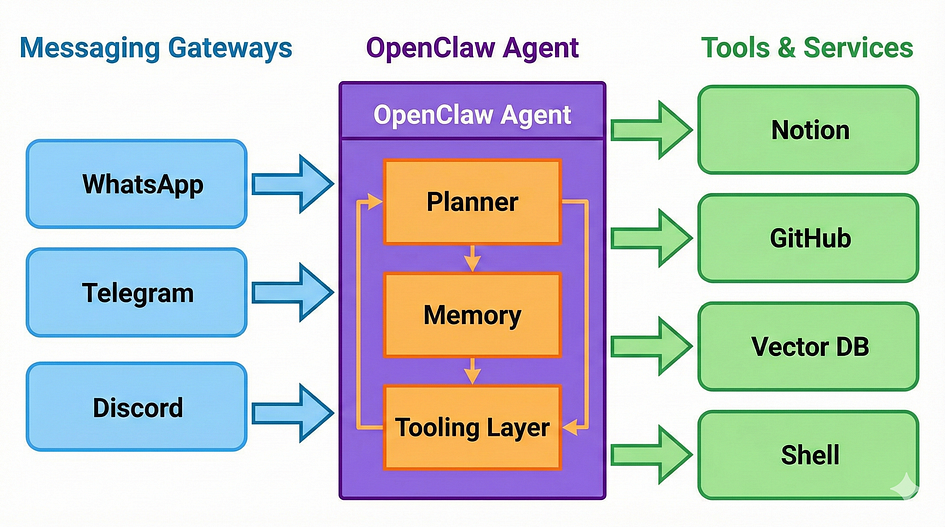
One of Clawdbot’s most practical features is that you can interact with it through familiar messaging platforms such as WhatsApp, Telegram, Discord, or Slack. This removes friction and allows you to trigger workflows without learning a new interface.
6. Real Tool Execution
Clawdbot doesn’t just suggest actions — it performs them. It can run shell commands, call APIs, modify files, and trigger external systems. This ability to execute real operations is what sets it apart from conversational AI tools.
7. File System Awareness
The agent can read, analyze, summarize, and generate files directly on your system. Whether it’s scanning logs, summarizing documents, or creating reports, Clawdbot understands directory structures and file contexts.
8. Built-In Integration Mindset
Clawdbot is designed to integrate with real-world tools such as GitHub, Notion, Google Calendar, CRMs, and internal enterprise APIs. This makes it suitable not only for personal productivity but also for business workflows.
9. Retrieval-Augmented Generation (RAG)
By connecting Clawdbot to a vector database, you can ground its responses in your actual documents, policies, and knowledge bases. This significantly reduces guesswork and improves the accuracy of its decisions.
10. Background Jobs and Scheduling
Clawdbot can run tasks on a schedule. Daily summaries, overnight checks, and periodic monitoring jobs can all be automated without manual intervention.
11. Human-in-the-Loop Safety
For sensitive actions such as deployments or financial operations, Clawdbot can pause and ask for human approval. This creates a balance between automation and control.
12. Fine-Grained Permission Controls
You decide what Clawdbot is allowed to access. Specific directories, commands, and APIs can be enabled or restricted to reduce the risk of unintended actions.
13. Observability and Action Logs
Every plan, tool execution, and outcome can be logged. This transparency is critical for debugging, audits, and building trust in an autonomous system.
14. Error Handling and Self-Correction
When something fails, Clawdbot doesn’t simply stop. It can retry, adjust its approach, or report the issue with meaningful context, making it more resilient than basic automation scripts.
15. Large Document Handling
Clawdbot can work with documents that exceed a single model’s context window by chunking and streaming information intelligently. This is especially useful for reports, policies, and technical documentation.
16. Multi-Agent and Skill-Based Design
Different tasks can be handled by specialized skills or sub-agents. This separation keeps complex workflows organized and easier to maintain.
17. Memory Inspection and Forgetting
You can review what Clawdbot remembers and delete specific entries when needed. This is important for privacy, accuracy, and long-term system hygiene.
18. Cost Awareness and Model Optimization
Clawdbot can be configured to use lower-cost models for routine tasks and reserve more powerful models for complex reasoning, helping manage AI usage costs.
19. Developer-Friendly CLI and Setup
From installation to configuration, Clawdbot is built with developers in mind. Clear logs, configuration files, and CLI tools make it approachable for technical users.
20. Open Source and Community Driven
Clawdbot is fully open source. You can inspect the code, extend it with custom skills, and benefit from a growing community that continuously improves the ecosystem.
Closing Thoughts
Clawdbot (now OpenClaw) is compelling not because it promises the future, but because it delivers something useful today. It shows what happens when AI is allowed to remember, reason, and act — while remaining under human control. As agentic systems continue to evolve, Clawdbot stands as an early but practical example of how AI can move from conversation into real, everyday work.
Leave a Reply